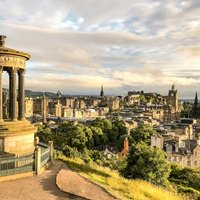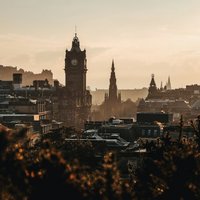

The canonical story of Harry Potter’s origins places Joanne Rowling in a cafe in Edinburgh, writing by hand in an exercise book while her baby daughter slept in a pram beside her, too poor to heat her flat, seeking the warmth of the cafe as a practical necessity. This story is true in its general outline and misleading in several of its specifics, and the distortions reveal something about how Edinburgh has related to its most commercially successful author.
Rowling moved to Edinburgh in December 1993 to be near her sister Di, who lived in the city. She had begun planning Harry Potter in 1990, on a delayed train from Manchester to London, before she had any connection to Edinburgh. The world-building – Hogwarts, the Quidditch rules, the structure of the magical government, the characters – was substantially developed during the years she spent in Portugal teaching English and during her marriage to Jorge Arantes, which ended in separation in late 1993. Edinburgh did not produce the idea of Harry Potter.
Nicholson’s Cafe
What Edinburgh gave her was the time, the circumstances and the specific texture of the city during a difficult period of her life. Rowling was living on benefits in a flat in Leith after leaving Portugal, a single mother with a baby, suffering from depression significant enough that she sought treatment for it. She has written about this period with some candour: the shame of signing on for benefits, the isolation, the specific Edinburgh quality of grey winter light that does not encourage optimism.
Nicholson’s Cafe on Nicholson Street – owned by her brother-in-law Roger Moore, who ran it as a jazz cafe – was a warm place to sit. She went there with her daughter Jessica and wrote. The cafe was quiet enough in off-peak hours to work in, and Moore let her sit without pressure to buy more. She was writing on the cafe’s tables, but she was not escaping from an unheated flat as a matter of survival; she was using a family connection to find a congenial workspace during a difficult year.
The Elephant House
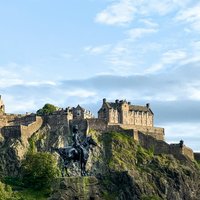
The Elephant House on George IV Bridge, which markets itself heavily as “the birthplace of Harry Potter,” is the cafe most visitors associate with the Rowling mythology. She has confirmed she wrote in the Elephant House, as well as in Nicholson’s and other Edinburgh cafes. The Elephant House’s view of Greyfriars Kirkyard and Edinburgh Castle is striking, and visitors have covered its toilets in graffiti messages to Rowling and Potter for years. The cafe has capitalised on this association effectively. The degree to which the specific environment influenced the specific content of the books is, as with all questions about creative inspiration, unanswerable.
What the City Gave Her
The first Harry Potter book was published in June 1997. By then Rowling had finished her PGCE at Moray House and was teaching French in Edinburgh secondary schools. She had an agent, Christopher Little, and a small advance from Bloomsbury. The transformation from the circumstances of 1993-94 was gradual rather than sudden.
Edinburgh gave Rowling four years of material poverty and emotional difficulty during which she finished the first book that made her a billionaire. The city also gave her a home that she has largely maintained: she has lived in Edinburgh on and off since 1993 and owns a substantial house in the Morningside area. The relationship between writer and city is not simple gratitude. It is, at this point, one of the defining public facts of both.
Corrections
Spotted something wrong? Send a correction.