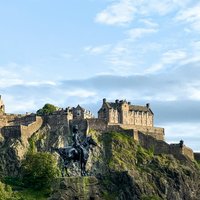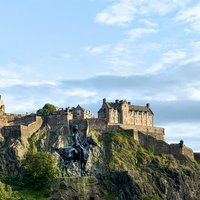

Edinburgh’s skyline is so distinctive that it is used as a visual shorthand for the city on every poster, postcard and background photograph. The castle on the rock. Arthur’s Seat on the horizon. The medieval ridge of the Old Town against the sky. All of it volcanic. All of it formed roughly 350 million years ago when Edinburgh was sitting close to the equator and a series of volcanoes were pushing through the crust of an ancient continent.
The Volcanic Structure
The Edinburgh area sits on a volcanic field that produced at least seven distinct volcanic centres. The Castle Rock – the volcanic plug on which Edinburgh Castle sits – is the solidified lava that filled the core of a volcano whose outer layers were stripped away by glaciation. Arthur’s Seat is the eroded remains of a volcano that was considerably larger, with the Lion’s Head and Lion’s Haunch forming the remnant of the eastern side. Calton Hill, the Braid Hills, Blackford Hill, Corstorphine Hill – all volcanic or associated with volcanic activity from the same period.
The Glacial Explanation for the City Shape
The reason Edinburgh looks the way it does – the castle on a high rock, the ridge of the Old Town falling away to the east, the valley of Princes Street Gardens between them – is directly explained by the last ice age. The glaciers moving from west to east encountered the hard volcanic plug of the Castle Rock and were deflected around it, leaving a sheltered ridge of softer rock on the eastern side that became the Royal Mile. The shape of the Old Town, the defensive advantage of the castle site, the logic of the whole medieval city – all of it is geology.
James Hutton and the Birth of Modern Geology
Edinburgh is also where modern geology was invented. James Hutton, an Edinburgh physician and farmer, published his Theory of the Earth in 1788 after examining the rock formations at Siccar Point on the East Lothian coast. Hutton’s insight – that the Earth was vastly older than scripture suggested, shaped by the same slow processes that could be observed in action – was fundamental. He used Edinburgh’s geology extensively in developing his argument. The unconformity at Hutton’s Section in Holyrood Park, where ancient red sandstone meets younger volcanic rock at the foot of Arthur’s Seat, is a site where he worked out part of his evidence.
Walking the Geology
The walk up Arthur’s Seat is a geology walk whether you know it or not. The lower slopes are ancient sedimentary rock, marine in origin. The upper sections are volcanic basalt and tuff. The summit is the neck of the old volcano. Looking back from the top, the Castle Rock is visibly the same geological story at a different scale. Edinburgh is a city that grew in the gaps between volcanic obstacles and that alignment between human settlement and geological accident has defined its character entirely.
Corrections
Spotted something wrong? Send a correction.